
Storing lyophilized research peptides: temperature, moisture and light
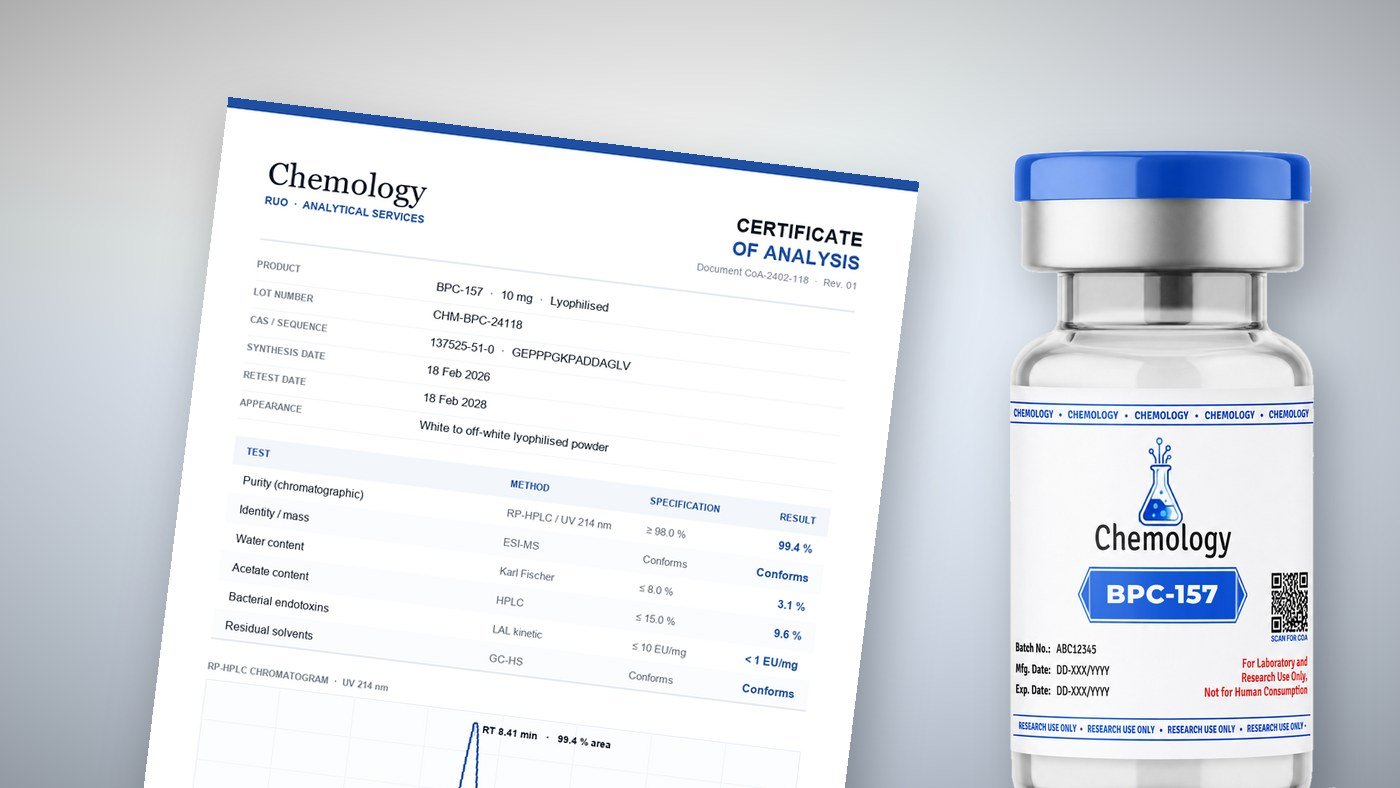
Lyophilized peptide arrives as a stable solid and stays that way under the right conditions. Most degradation seen in the laboratory is not a manufacturing problem. It happens after delivery, and it happens for reasons that are well understood and largely avoidable.
Why material is supplied lyophilized
Lyophilization removes water by sublimation under vacuum, taking the solvent from solid directly to vapor without passing through a liquid phase. What remains is an amorphous cake with a very high surface area and very little residual water.
That matters because the reactions that degrade peptides mostly require water. Hydrolysis of the peptide backbone, deamidation of asparagine and glutamine residues, and the succinimide rearrangements that follow deamidation are all water-mediated. Removing the water does not stop them. It slows them by orders of magnitude.
The trade-off is that the same high surface area which makes a lyophilizate easy to redissolve also makes it hygroscopic. An open vial in a humid room takes up atmospheric moisture quickly, and the material that results is not the material that was tested.
Temperature
Degradation rates follow the Arrhenius relationship, which describes how reaction rate scales with temperature:
Arrhenius equation
k = A x e^(-Ea / (R x T))
Where k is the rate constant, A is the pre-exponential factor, Ea is the activation energy, R is the gas constant and T is absolute temperature. The practical consequence is that rate does not fall linearly as you cool material. It falls exponentially.
This is why the storage temperature stated on a certificate of analysis is not arbitrary, and why the difference between storage conditions is larger than the numbers suggest. A material held well below its stated condition is not merely a little more stable. It is substantially more stable.
The condition that applies to any given lot is stated on that lot’s certificate. Different sequences behave differently, and a general rule is a poor substitute for the document issued for the material in front of you.
Freeze-thaw cycling
Repeated warming and cooling is more damaging than a single storage temperature slightly above ideal. Each cycle allows the vial to warm through the dew point, condensation forms on the cold interior surface, and the lyophilizate takes up that water.
Two habits reduce this substantially. Allow a vial to reach room temperature fully before opening it, so condensation forms on the outside of the glass rather than on the material. And aliquot on first opening, so that subsequent work draws from a small portion rather than cycling the whole lot.
Moisture
Residual water in the lyophilizate is measured by Karl Fischer titration, and where it is reported it appears on the certificate as a percentage of total mass. Several percent is common and not a defect.
What matters is that the figure was measured at release and describes the material as it left the laboratory. Water taken up after delivery is not on the certificate, and it displaces peptide from the mass without changing the appearance of the powder at all.
Desiccant in the storage container addresses this cheaply. So does minimizing the time a vial spends open.
Light and oxygen
Tryptophan, tyrosine, phenylalanine, methionine and cysteine are the residues most susceptible to photo-oxidation. Amber glass, opaque secondary packaging or simply a closed drawer all remove the variable.
Oxidation shows up in mass spectrometry as a mass increase, and a shift of around 16 mass units is the classic signature of a single oxygen addition, most often at methionine. If a lot was clean at release and shows that shift on re-analysis, storage conditions are the first place to look.
What the certificate does and does not tell you
A certificate of analysis reports the material as tested, on the date stated, under the methods listed. It is a record of a point in time.
It is not a warranty of future condition, and it cannot account for what happens after delivery. Retest dates exist for that reason: they indicate when the issuing laboratory considers the reported figures should be confirmed again, not when the material becomes unusable.
Where storage matters to a result, the useful record is the certificate plus your own log of how the material was held. One without the other explains half of what happened.
A short protocol
- Log the lot number and arrival condition on receipt, and file the certificate against the lot.
- Store within the conditions stated on that certificate, protected from light.
- Allow vials to reach room temperature before opening, every time.
- Aliquot on first opening rather than returning to the parent vial.
- Keep desiccant in the storage container.
- Record dates of opening and any deviation from stated conditions.
None of this is onerous, and all of it is easier than accounting for a result that cannot be explained.
[chm_ruo_note]